

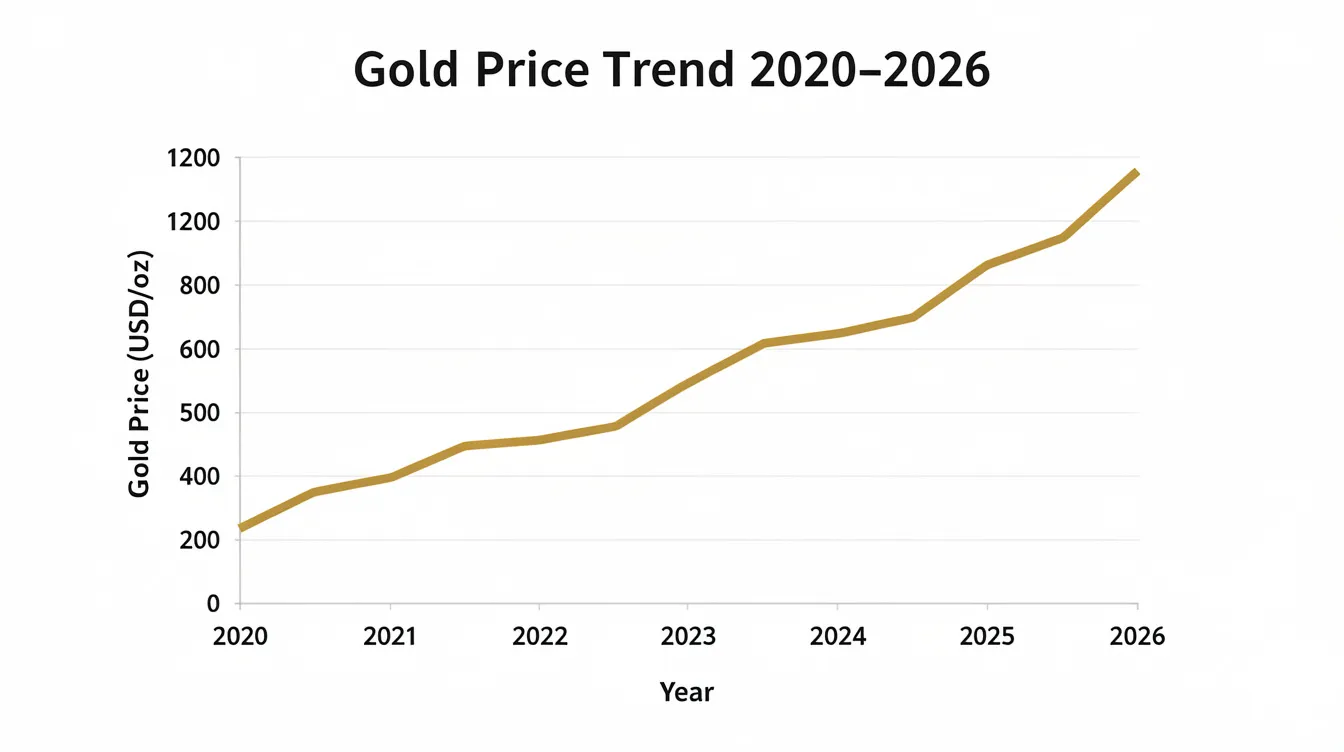
Since 2024, shifting U.S. and global tariff policies have coincided with a powerful gold bull market, with gold prices moving above $4,500 per troy ounce by March 30, 2026. This year’s outperformance has drawn significant attention from retail investors and institutions alike.
The gold market has experienced a remarkable transformation over the past two years. Gold rose roughly 55–70% in 2025, crossed above $4,000 per ounce for the first time, and traded around $4,567/oz on March 30, 2026. This bull market has made the precious metals space one of the most closely watched areas across other asset classes.
This extended rally has coincided with aggressive use of tariff tools by the U.S., including IEEPA, Sections 232 and 301, and ongoing trade tensions among major economies. The U.S.–China and U.S.–EU frictions have created persistent market volatility that appears to have channeled capital toward non yielding gold as a debasement hedge.
This article explores how evolving tariff regimes, the Supreme Court’s decision to review emergency powers, and global trade tensions might influence gold prices, demand, and regional market dynamics through 2026–2027. Understanding these connections may help investors assess how trade policy intersects with their investment objectives.
Tariffs are taxes imposed on imported goods, typically designed to protect domestic industries or address trade imbalances. When implemented broadly, they can alter growth expectations, inflation dynamics, and currency valuations—all factors that may influence commodity prices and gold demand.
The transmission channels linking tariffs to gold prices operate through several pathways. The impact on the U.S. dollar tends to be significant, as broad tariff regimes often invite retaliatory measures that can reduce U.S. export competitiveness, potentially leading to a weaker dollar. Since gold is priced in USD globally, dollar weakness historically supports higher prices for spot gold.
Changes in inflation expectations represent another key channel. The Yale Budget Lab estimated that a hypothetical 15% universal tariff could add 2–3% to global inflation, and investors often turn to gold as an inflation hedge during such periods. Shifts in global growth sentiment also matter considerably—when tariffs threaten to slow GDP growth, risk appetite typically declines, and safe haven demand for assets like gold and money market funds tends to increase.
Investment grade gold is frequently exempt or partially shielded from direct tariffs when imported for investment purposes in major markets. This means price effects tend to arise more from macro and sentiment channels than from direct tariff costs on gold bars or coins.

The use of the International Emergency Economic Powers Act for tariffs became a central legal and political issue starting in 2024. Originally designed for sanctions and asset freezes during declared national emergencies, IEEPA was invoked to justify broad tariff threats beyond traditional trade statutes.
Key milestones unfolded in sequence. Presidential proclamations in late 2024 and early 2025 used IEEPA for tariff threats on multiple trading partners. By early 2025, the White House chose to exempt investment-grade gold imports from certain IEEPA tariffs, which appeared to calm fears of direct cost increases for bullion and gold etfs.
The Supreme Court granted certiorari in late 2025 to scrutinize whether IEEPA’s “regulate importation” clause authorizes revenue-raising tariffs. Oral arguments occurred in early 2026, with a decision expected in the coming months. This legal uncertainty has overlapped with gold’s continued uptrend.
During the height of IEEPA tariff uncertainty in mid-2025, central bank purchases reached elevated levels, with projections of 800 tons globally in 2026. COMEX inventories swelled as traders stockpiled physical metal, and etf demand remained strong despite the trade overhang.
The Supreme Court’s review focuses on whether Congress clearly authorized the President to impose tariffs under IEEPA, or only to regulate imports through licensing and controls. This distinction carries significant implications for executive trade powers.
Major legal doctrines have entered the debate. The major questions doctrine, applied in cases like West Virginia v. EPA (2022), demands explicit congressional authorization for policies with vast economic impact. Non-delegation concerns question whether IEEPA’s broad terms unconstitutionally transfer legislative power to the executive branch.
During oral arguments in early 2026, several Justices questioned whether “regulate importation” legitimately includes broad revenue-raising tariffs unrelated to narrow national security threats. The questioning suggested skepticism about whether tariffs on allies over issues like Greenland policy disputes qualify as responses to “unusual and extraordinary” threats.
While the ruling remains pending, observers consider outcomes ranging from modest limits on IEEPA tariff use to more sweeping restrictions that would push future tariff actions toward statutes like Sections 232 and 301, which require more specific findings.

Tariff-related court decisions may influence gold mainly through fiscal dynamics, bond markets, and the U.S. dollar rather than via direct changes to gold import costs. The indirect pathways could prove more consequential for investors considering whether to purchase gold.
A decision curtailing IEEPA tariffs could reduce expected tariff revenue, potentially increasing Treasury borrowing needs. Over time, this might elevate term premiums on U.S. government bonds. Increased fiscal pressure, combined with a federal reserve easing cycle expected to continue into 2026, might weigh on real yields—a factor that historically tends to favor non yielding assets like gold.
The removal or narrowing of IEEPA tariffs could lower policy uncertainty in some sectors while raising questions about alternative tools. Section 232 for national security tariffs, Section 301 for unfair trade practices, and Section 122 for balance-of-payments measures could see increased use. UBS strategist Joni Teves has projected gold averaging near $4,750 in early 2026 quarters, with us federal reserve rate cuts providing support.
If markets interpret a ruling as weakening U.S. trade leverage, the U.S. dollar could trend softer over time. A weaker dollar often supports gold priced in USD, though this relationship has shown instability in recent years.
This section walks through plausible macro and gold-market scenarios if the Court materially limits IEEPA tariff authority. Markets have partially priced in some continuity, but a clear ruling could trigger repositioning.
In an initial reaction phase, risk appetite might improve briefly on reduced tariff overhang. Equities could rally while the dollar rebounds, potentially causing a short-lived pullback or consolidation in spot gold price—perhaps 5–10% similar to technically driven sell-offs observed in late january 2026 after record highs.
A medium-term adjustment phase could see higher expected federal deficits and new, more targeted tariffs under Section 232 or 301 keep uncertainty elevated. This environment would likely support sustained allocations to gold by central banks and institutional investors. Central bank demand projections of 800 tons in 2026 reflect this structural bid.
Across scenarios, structural drivers may continue supporting gold. Global debt levels above $340 trillion, central bank diversification away from the U.S. dollar, and robust ETF inflows from emerging markets suggest that downside risks may be cushioned even if volatility increases.
Tariff decisions in 2025 influenced regional gold premiums and logistics more than the global spot price. The primary effect appeared in flows between London OTC markets and U.S. futures hubs like COMEX in New York.
During periods of tariff uncertainty, market participants repositioned physical metal to jurisdictions perceived as less exposed to potential trade frictions. This created temporary price differentials of $20–50 per ounce between London and New York. COMEX inventories rose as traders brought more metal into U.S. warehouses, partly anticipating possible disruptions.
If broad tariffs were narrowed or unwound, physical trade might rebalance. U.S. premiums could compress relative to London and Asian markets, potentially increasing arbitrage activity. Zurich and other tariff-light hubs have already seen repositioning from traders managing these dynamics.
Tariffs and trade policies affect the gold market differently across major regions, especially where domestic currency, growth, and policy mix diverge.
In the U.S., tariff headlines and legal reviews have intersected with expectations of fed policy easing and high fiscal deficits. These factors have channeled retail demand into ETFs, with gold etfs seeing strong inflows throughout 2025–2026. Gold’s role as a portfolio hedge has gained attention during this period of stock market uncertainty.
China faces effective tariff rates of 47.5–55% across over 70% of U.S. import lines, creating significant trade isolation. Combined with property market weakness, this environment has spurred a 28% surge in Chinese gold investment demand. The People’s Bank of China has accelerated gold reserves accumulation as part of broader currency debasement concerns and de-dollarization efforts. Insurance-linked gold allocation programs introduced in recent years have further boosted retail access.
Broader APAC markets show varied dynamics. India benefited from a February 2026 deal with the U.S. that slashed tariffs to 18% from 50%, strengthening the rupee to 90.27/USD—its best level in three years. Base import prices dropped by $50 per 10 grams, supporting retail investors and jewelry demand. Japan has seen yen weakness support local gold flows despite existing duties, demonstrating how currency dynamics interact with global tariff developments.
Gold may serve as a potential tool for investor diversification and risk management when tariff and trade policies remain in flux. However, appropriate positioning depends on individual circumstances and should not be considered investment advice.
Different investor types approach gold through various channels. Retail investors often favor gold etfs and coins for their liquidity and accessibility. Institutions may use futures and OTC swaps for hedging purposes, while central banks maintain strategic reserve allocations as part of broader gold holdings.
Some portfolio managers have responded to tariff-related market volatility by adjusting gold allocation toward a 3–5% range of total assets. This approach recognizes gold’s potential as a debasement trade while acknowledging its nature as a non yielding asset with associated opportunity cost. Actual allocations depend on investment objectives and constraints specific to each investor.
Pairing gold with other precious metals like silver, platinum, and palladium—along with safe haven assets like high-quality government bonds and mutual funds—can help build a multi-asset hedge against trade and policy uncertainty. The world gold council has documented how modest gold tilts may provide drawdown mitigation during trade shock periods, though past performance may not predict future results.
Tariff and customs rules can differ by product type, so investors may want to understand distinctions among physical bullion, coins, ETFs, and futures when considering how to access gold exposure.
Tariffs and import duties may apply to jewelry and some forms of physical bullion in certain jurisdictions, while investment-grade gold bars and coins might receive more favorable treatment. Under recent U.S. policy episodes, gold imported for investment has been explicitly exempted from IEEPA-related tariffs, limiting direct cost impacts.
Exchange traded fund products offer liquidity advantages and eliminate storage concerns, as the fund handles physical custody. They track spot gold prices effectively but carry counterparty risk. Holding physical gold directly provides sovereign risk diversification but requires storage and insurance arrangements.
Futures and derivatives may allow short-term hedging of tariff-related risks, though they involve leverage, rollover costs, and basis risk. Many long-term investors prefer to avoid these complexities. Regulatory and tax treatment, including country-specific import duties, can change over time—consulting professional advice remains prudent.
Between now and 2027, gold’s trajectory appears likely influenced by how trade tools evolve, how courts define limits on emergency tariff powers, and how these shifts interact with monetary policy and global debt. The long term trend will depend on multiple interconnected factors.
A cautious base case suggests gold may consolidate in a high range of $4,000–$4,500 per ounce while central bank purchases remain strong and tariff risks moderate without disappearing entirely. The bull case envisions conditions remain strong for consecutive years if macro tailwinds persist.
A supportive scenario could emerge if slower growth, ongoing trade friction, and a weaker dollar help gold gradually test higher prices, especially with central banks in emerging markets continuing to diversify away from dollar assets. Total holdings in ETFs and official reserves could reach new highs under such conditions.
A bear case scenario involves stronger-than-expected global recovery and reduced trade tensions supporting risk assets and the dollar, possibly creating downward pressure on gold. However, structural investor demand from central banks and long-term investors may still provide a floor, limiting the same period losses seen in previous corrections.
Tariff developments represent one piece of a broader puzzle that includes interest rates, inflation, geopolitics, and structural portfolio trends. Commodities broadly, and gold specifically, will continue responding to this complex interplay of factors. Investing in the yellow metal requires consideration of how these elements may interact, recognizing that good investment decisions depend on individual circumstances.
In many major markets, investment-grade gold bars and certain coins are often exempt from broad-based tariffs or enjoy more favorable treatment than jewelry or semi-finished products. This varies by jurisdiction and can change over time.
Under recent U.S. policy episodes, gold imported for investment has at times been explicitly exempted from IEEPA-related tariffs, helping limit direct cost impacts for bullion investors. Readers may want to check current customs and tax rules in their own country, as these differ substantially across regions.
The Court focuses on legal authority rather than gold prices directly, but the ruling could influence markets by changing expectations for tariff revenues, fiscal deficits, and future trade actions.
If markets expect more borrowing and lower real yields from constrained tariff powers, this environment has historically been associated with stronger support for gold. However, outcomes remain uncertain, and shorter-term price reactions could move in either direction depending on how investors interpret implications for growth, the dollar, and risk assets.
Tariffs on industrial commodities like steel, aluminum, or manufacturing inputs may influence growth and inflation expectations, potentially affecting gold as an inflation hedge or safe haven. If tariffs trigger supply chain disruptions or retaliatory measures, broader market uncertainty might lead some investors to increase gold exposure.
Relationships are complex—in some cases, trade tensions might strengthen the U.S. dollar, which can offset or delay bullish effects on gold despite elevated uncertainty.
Historical evidence does not show a simple, one-way relationship between tariffs and gold prices. Outcomes appear to depend on the wider macroeconomic and policy backdrop.
In some periods, tariff escalations coincided with gold rallies due to risk aversion. In others, strong growth or a firm dollar dampened gold’s response. Investors may wish to consider tariffs as one factor among many—alongside interest rates, inflation, fiscal policy, and central bank demand—when forming views on gold.
Monitoring official announcements on trade measures from major economies provides a starting point, along with following central bank communications and major court decisions affecting executive trade powers.
Tracking reputable sources that provide regular updates on gold prices, ETF flows, and central bank demand can help maintain awareness of relevant market dynamics. Some investors find value in speaking with financial or legal professionals when assessing how specific tariff measures or rulings could interact with their portfolios and risk tolerance.